
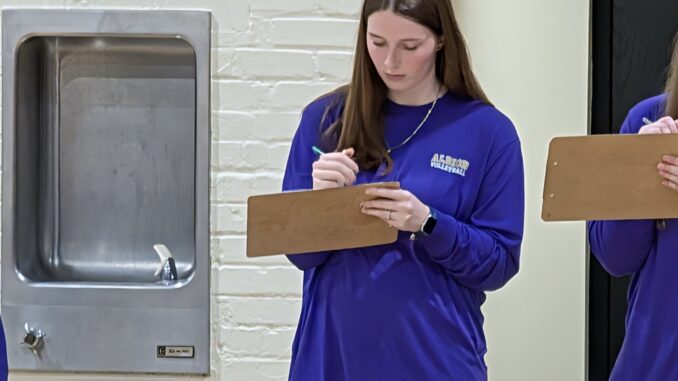
She fills water bottles before you realize they’re empty. She jots down players’ statistics and cheers simultaneously. She knows the ins and outs of the game without actually being on the court. She’s not a coach, athletic trainer or Superwoman: She’s a student assistant.
“She” is me. I joined the Albion volleyball team as a bushy-tailed first-year hoping to start varsity and make All-American, yet I ended my athletic career as a team manager. Never fear; this isn’t a sob story about regretting my life choices – it’s quite the opposite. Shifting my role from player to student assistant taught me invaluable lessons about being human.
In the end, I learned that being part of an athletic team is about more than becoming an All-American or receiving a senior gift from my teammates. The things I learned from Albion volleyball were intangible, but they’ll stay with me for the rest of my life.
It’s Okay for Your Path to Change
I want to emphasize that I love volleyball. I started playing in second grade and, upon falling in love with the sport, never missed a season. It’s the perfect amount of exercise without endless sprinting – soccer and basketball, I’m looking at you. Plus, intramural adult leagues and beach volleyball exist for a reason: The sport is a great workout even for nonathletes, and it’s genuinely fun.
Like I said, I began my college career as a volleyball player, not a student assistant. Although I never started or even stepped foot in a varsity game, I did play junior varsity (JV) all three seasons I was on the roster, and I had a blast doing so.
I won’t lie and say I would’ve chosen to be a student assistant without my coach presenting the opportunity to me in the spring semester of my junior year. I assumed I’d be on the roster all four years, and by year three, I’d grown somewhat comfortable being a benchwarmer. But when my coach asked if I’d like to contribute to the team differently, I was intrigued.
I had three options before me: accept her offer to become a student assistant, stay on the team knowing I likely wouldn’t play JV my senior year or quit the team entirely.
The easiest option would’ve been to quit. I could’ve decided to be dejected that I’d never played varsity and just given up. But whether it’s finishing a movie I’m not loving or staying true to a four-year commitment, I’m no quitter.
When I became a student assistant, the first thing I felt was something akin to relief. I didn’t have to try to prove myself anymore. I’d go to practices and matches and know exactly what my responsibilities were, and I’d do my best at my new role. I found that I loved stat-taking, and I actually preferred being on the sidelines to being on the court.
I learned that although the reality of my collegiate athletic experience subverted my expectations, I loved the end result. I’ll carry that with me for the rest of my life. I now know that role changes needn’t be feared, because changes in perspective are often rewarding.
Show Up, but Take Care of Yourself
It might be cliché to say that being on a sports team taught me to never give up, but it’s true. Working hard matters. That hard work is just as valuable when you’re tired and you’re not getting any playing time.
Those are the moments when you learn how gritty you can truly be. By challenging myself to reach my highest potential, I found myself lifting heavier weights and running faster – even if the playing time wasn’t there, the physical benefits were. You’ll never know how successful you can become until you push past your limits.
That being said, you have to know yourself well enough to take a step back if needed. Hard work is important, but even more important is your well-being. Your mental and physical health need to be in a good place before you can even consider putting effort into any extracurriculars.
Sometimes, you might not have the time or mental energy to continue playing a sport or working a job. It’s okay to quit. Truly, it’s not even quitting; it’s prioritizing yourself in a way no one else is going to. Only you can put yourself first, and if stepping away from something will bring you more joy than if you’d stayed, then you need to do it.
Controlling What You Can Control
Possibly the most critical thing I’ll take away from my athletic career is that in sports and in life, the only things you can control are your thoughts, actions and reactions.
Ultimately, I learned my playing time wasn’t decided by me. I put in countless hours trying to increase my vertical, waking up early for off-season lifts, staying up late doing homework after matches and spending more time at the gym than I did at the library. Still, it wasn’t enough to get that starting spot.
Looking back, I know I had unrealistic expectations. It’s hard coming into college to play a sport after starting all four years of high school. The reality check that you’re not the best player on the team anymore is anything but subtle, and over the years, I recognized I wouldn’t have the collegiate playing experience I’d imagined for myself.
So, I chose to let go of the pressure I was putting on myself and step into a role where I could contribute more to the team. I realized I’m responsible for my outlook on life.
By choosing to view setbacks as opportunities, being joyful as often as I can, putting in hard work and realizing it is what it is, I live a much happier life. I control what I can control, and although many things are uncontrollable, the life I’m living with this mindset is immensely fulfilling.
See You Later, Volleyball
Moving beyond volleyball is difficult for me. It’s been an integral part of my life for roughly 15 years, and suddenly, I’ve entered a season where I have no practices or matches to attend. There are no more team lifts, no more statistics to take, no more early morning bus rides or travel lunches with the women who’ve grown to become my best friends.
Without a doubt, change is hard. Separating myself from volleyball makes me sad, but I don’t allow myself to dwell on that sadness too much, because I know this isn’t really the end. I still have my friends and countless memories, and let’s be honest: I’ll always be a volleyball player at heart.
I’ll take pieces of this sport with me throughout my life. I’ll bump, set and hit a volleyball with my family at summer barbecues. Who knows, maybe I’ll join an intramural league. But one thing is certain: This sport and the people it’s brought into my life have changed me irrevocably, and I couldn’t be more grateful.
Leave a Reply