
Content warning: Spoilers for “Hamnet” (2025) ahead.
I’m going to say something that may discredit me as an English major forever: I have never read Shakespeare’s “Hamlet.” Okay, maybe I read part of it in high school, but controversial as it may be, many of his works are indistinguishable in my mind. This is in part because I read them so long ago, and partly because his writing can be difficult to understand.
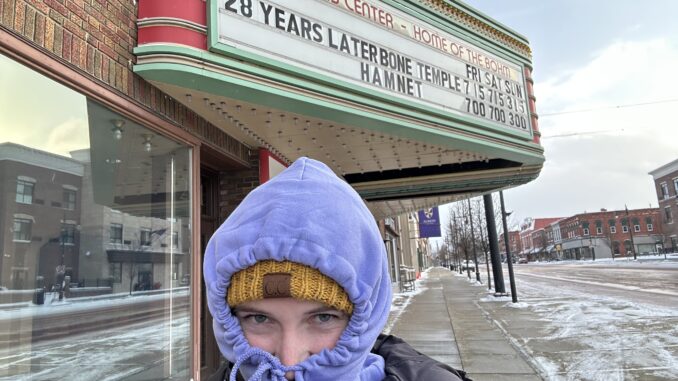
Still, on Friday night, I drove myself to my first solo visit to a movie theatre, braving the below zero temperatures to reach Albion’s beloved Bohm Theatre. There, I watched “Hamnet” (2025). Yes, you read that right. Oscar-nominated director Chloé Zhao’s 2025 film is spelled with an “n,” not an “l.”
The film is an adaptation of a 2020 novel “Hamnet: A Novel of the Plague” written by Maggie O’Farrell. According to Smithsonian magazine, O’Farrell was inspired to write the novel after learning in school that “the names Hamnet and Hamlet were considered interchangeable in Elizabethan England.”
Again, I have practically no memory of Shakespeare’s “Hamlet”; I essentially went into this film with little to no knowledge of its plot. Regardless, the cinematography and actors’ performances moved me to tears.
All the World’s a Stage for These Actors
It’s important to note that despite my mentions of Shakespeare thus far, the film itself actually doesn’t refer to the main character by name until nearly the end, and in O’Farrell’s novel, the name “Shakespeare” is never mentioned.
Nonetheless, Paul Mescal plays William Shakespeare. The Bard’s wife, named Agnes in the film – there’s debate over whether his actual wife was named Anne or Agnes – is played by Jessie Buckley. Their children are Susanna – the eldest daughter – played by Bodhi Rae Breathnach, and twins Hamnet and Judith, played by Jacobi Jupe and Olivia Lynes, respectively.
It’s not often I cry during movies – or in general, honestly – so you know the acting had to be top-tier for me to use my popcorn napkin as a tissue.
All the actors’ performances were excellent; there was never a moment where I thought a line could’ve been delivered more passionately or the tone felt contradictory to the screenplay’s intention. That being said, Buckley in particular absolutely nailed her role.
If you didn’t see the spoiler alert, don’t say I didn’t warn you: Hamnet dies in the film, and Shakespeare isn’t home to bid him farewell because he’s developing his playwright career in London. Agnes, having to bear the burden of her son’s loss on her own, is understandably upset with her husband for not being there.
In the film’s final scene, while Agnes watches “Hamlet,” she locks eyes with her husband who is standing beside the stage. Here is where Buckley’s incredible microexpressions truly shine. The couple share extended, emotional eye contact through which we can see she forgives him for his shortcomings.
Agnes sees the fruit of Shakespeare’s labors and the homage his play pays to their lost son. She also appears to recognize that everyone grieves in their own way, and her husband coped by creating art to ease the pain he felt over Hamnet’s death.
Though the actual creation of “Hamlet” was never confirmed to be about Hamnet – who was a real person and Shakespeare’s only son, and died at age 11 – O’Farrell’s novel imagined a world in which those connections were transparent.
It wasn’t only Buckley’s acting that made me cry during this film, though. There’s a scene prior to Hamnet’s death when it seems Judith will die of the bubonic plague, and Hamnet talks to his twin.
Jupe, age 12, performs like a seasoned actor at this moment. His character decides he can trick Death into taking him instead of his sister, and when he said, “You will stay, Jude. And I will go,” I was genuinely sobbing, ultimately thankful I’d gone to the theatre alone. I felt no need to reign in my emotions, and I heard other viewers sniffling as well.
Even if you read this article not realizing there would be spoilers, and were dismayed, I highly recommend going to see this film. I think we all need to be reminded of the value of art and its ability to draw emotions from us that we didn’t even know were buried.
Visuals That Made Me Wish I Could Time Travel
Despite currently writing a novel for my honors’ thesis about characters who are interested in cinematography, I have a minimal vocabulary when it comes to describing these aspects of film. My Letterboxd reviews are often variations on “loved this, it was very good!”
What I can say is the film’s lighting seemed to rely on the natural light provided by its film locations. Perhaps as a result, the quality was so clear, I genuinely felt as though I could step through the screen and into the English countryside.
Cinematography aside, this film gave me an intense desire to travel to England. The Tudor style homes and rolling hills filled me with a sense of UK-flavored yearning. As a writer, I was also enamored by Shakespeare’s desk setup in his attic, at which he wrote by candlelight below a window overlooking his sprawling yard.
As I was watching, I felt ready to book a plane ticket – and climb into a time machine – to travel to the exact setting of the film. Partway through the movie, however, the bubonic plague entered the picture and I decided to put the idea on the back burner forever.
Support Creatives, Whether They’re Oscar-Winners or Not
Sometimes, films nominated for prestigious awards don’t seem particularly intriguing to me, while some of my favorites remain unnominated – such as “Wicked: For Good” (2025), which received zero Oscar nominations.
In the case of “Hamnet,” though, the literary nature of the Oscar-nominated film – which has already won the Golden Globe’s Best Picture – intrigued me. It felt like a betrayal of my love of reading not to see a book-to-movie adaptation on screen. Any movie promoting the importance and significance of literature is a movie worth making.
As I’ve written before, declining literacy rates and a general lack of desire to read in our society are terrifying to me. If people can at least consume some form of these stories by watching a novel’s film counterpart, I consider it a win.
Whether you go on to read “Hamnet: A Novel of the Plague,” watch “Hamnet” or indulge in a book or movie of your choosing, I hope you’ll continue to support the people creating literature and media in their efforts to provide entertainment and knowledge.
I strongly recommend Kenneth Branagh’s film adaptation of Hamlet. It was shot in 70mm, the only version featuring the entire play, and features an amazing cast of actors.