
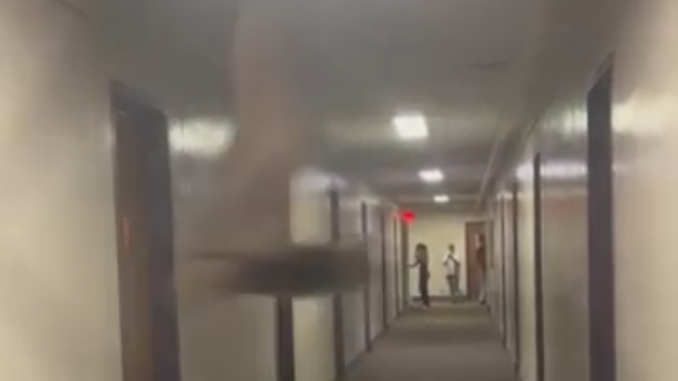
“Remember the time freshman year of college when there was a bat, and someone got bit?”
This is how Mt. Holly, New Jersey, first-year Paris Ford said she hopes to look back on her experience with a bat getting into her Wesley dorm room on Feb. 12.
There have been multiple cases of bats getting into Wesley, and according to students, responding Campus Safety officers have killed bats while removing them. Michigan’s bats are protected by the Department of Natural Resources as well as the Endangered Species Act, though the state offers permits for bat removal from structures.
While watching a show in her room on Feb. 12, Ford said she looked up to see a bat hanging onto a pipe near the ceiling of her room, where she thinks it was able to gain entry. After running out, Ford said she called Campus Safety. An officer came to her room and looked for five minutes before leaving, unable to find the animal.
“She said the layout of my room was perfect for bats to hide in, because I had a bunch of small crevices,” Ford said. “They can fit into holes the size of a quarter.”
A few minutes later, Ford said they found the bat tucked against the top corner of their desk’s corkboard. Ford said they called Campus Safety again but were told there might be a long wait. According to Ford, this time it took officers 45 minutes to arrive.
Ford said she was “freaking out,” waiting in the Wesley lobby, and asked an acquaintance, Holt first-year Seth Holtry, for assistance.
The Pleiad reached out to Holtry on Feb. 19 via email. Holtry declined to comment.
“He picks up the bat, and he literally just brings it outside,” Ford said. “He’s like, ‘Damn, I got bit,’ but he doesn’t care. He just throws it outside.”
Though Ford said the bat had a broken wing when Holtry removed it from their room, they did not see if the bat was alive when Holtry put it outside. They added that the bat was dead when Holtry took it to the hospital with him to be tested for rabies. According to the Centers for Disease Control and Prevention, bats “are the most reported animal with rabies.”
“The bat needed to be dead so Seth could take the bat to the hospital so he could get tested for rabies,” Ford said. “And then he got 20 inoculations.”
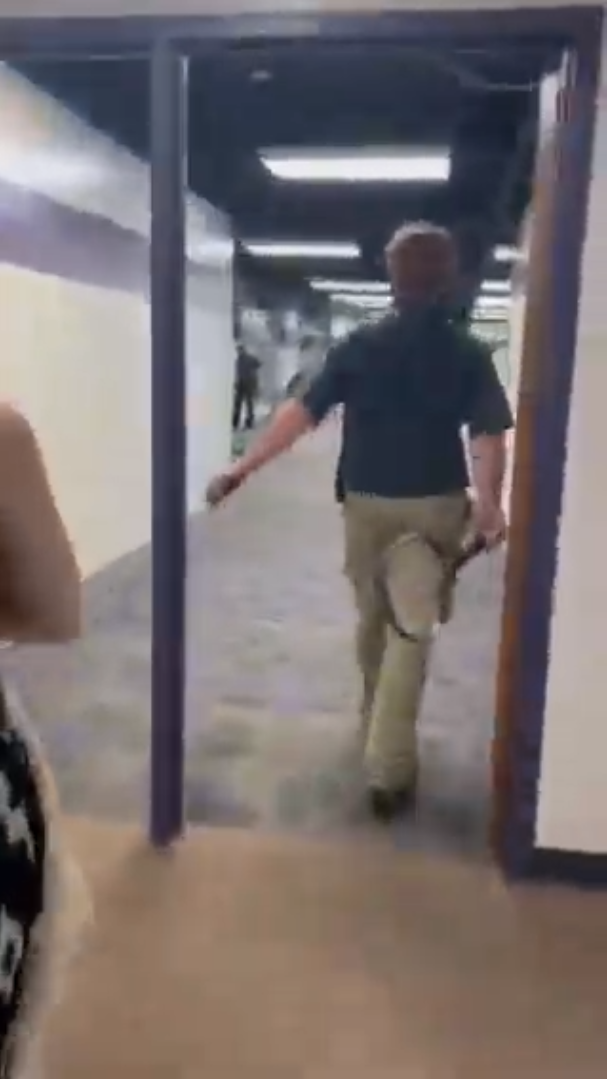
20 minutes after Holtry left, Ford said Campus Safety arrived “with a net and a tennis racket.”
The tennis racket is a tool San Diego first-year Liv Rodriguez said Campus Safety officers also brought to her Wesley dorm room after she noticed a bat had gotten in. Rodriguez said she has had bats in her room three times since starting the Summer Bridge Program in July.
The second time, in October, Rodriguez said the responding officer apologized to her for leaving a mess.
“The guy apologized, because he was like, ‘Yeah, this one was a crazy one. Like, I kind of trashed your room, and there might be, like, bat guts on your wall,’” Rodriguez said.
Rodriguez confirmed there was viscera left on her wall after the officer removed the bat. According to her, in each instance, the responding Campus Safety officer would hit the bat out of the air using a tennis racket.
Centennial, Colorado, first-year Delaney Fitzgerald said Campus Safety was called “once or twice a week” to remove bats from Wesley’s first-floor lobby and ground-floor lounges during their time in the Summer Bridge Program. In two of those instances, Fitzgerald said she witnessed the officer kill the bat. According to her, none of the officers came wearing anything protective, “just something to hit the bat with.”
“They would just chase it around wherever the bat was until they would manage to smack it,” Fitzgerald said. “Then they would just take it outside, and they would be done.”
In Rodriguez’s third encounter with a bat in her room, she said Campus Safety officers were “combative” and “had no interest in guaranteeing (her) safety.”
“I asked them, please, can you guys at least inspect the room, tell me how they’re coming in,” Rodriguez said. “And then they said that was beyond their job description.”
After this third occurrence, Rodriguez said her Community Assistant (CA) reached out to Director of Community Living Joey Koehn to inquire about how Rodriguez could prevent any future encounters to no response. Rodriguez added that her CA submitted a work order on her behalf, while she submitted two more, all to no response.
The Pleiad reached out to Director of Campus Safety Dave Leib via email on Sept. 22. Leib declined to comment. The Pleiad reached out to Leib again on Feb. 24 and 26, receiving an out-of-office response on Feb. 26. Koehn said he is serving as the interim director of Campus Safety until March 16.
Koehn said Campus Safety advises students who notice a bat in their space to “not engage,” vacate the room and call Campus Safety. It’s at this point, Koehn said, that Campus Safety calls Facilities to don a “bat suit” to capture and release the bat safely. According to Koehn, Campus Safety does not have any nets or tools to use when handling bats, and officers “defer” to Facilities.
Maintenance Supervisor Jeff Watson said though bats don’t “fly into you and try to attack you,” the bat suit is available for the safety and comfort of any responding Facilities team members.
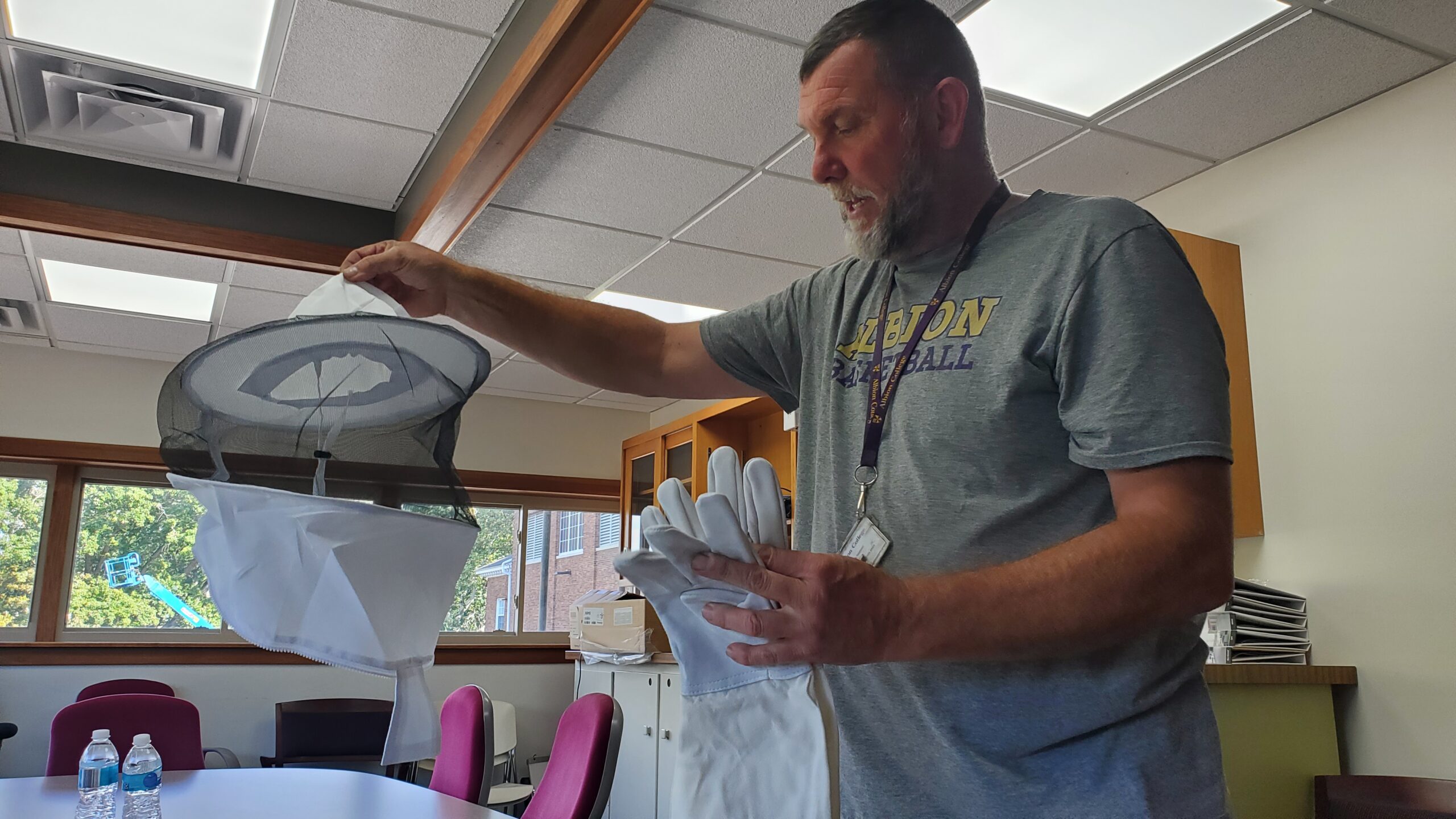
According to Watson, upon receiving a call, Campus Safety identifies “if they’re comfortable enough” to address the call themselves, but “for the most part, they call Facilities.”
“There’s occasions where the bat doesn’t survive,” Watson said. “We do our best to try to release the bat.”
In the future, Ford said they hope the college can find a way to “get the bats out of the buildings.” To their fellow students, Ford said to “be aware” of bats.
“Just watch the pipes, because I think it’s the pipes, and then look for tiny holes if you ever see them,” Ford said. “Don’t get close, because you will have to get poked with a needle 20 times.”
Leave a Reply