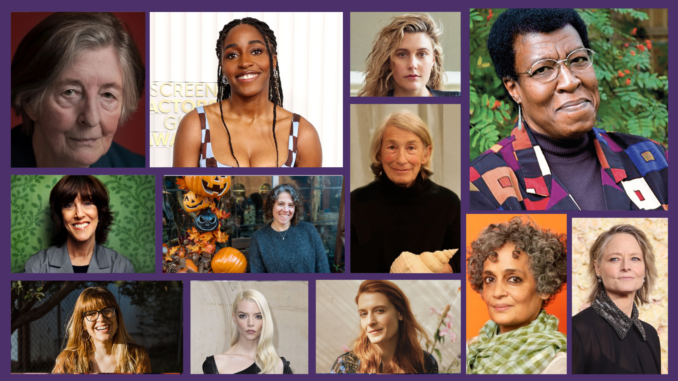
Across every section of the Pleiad, our staff works to recognize the influence of women in their fields, our campus environment and the media we consume. From journalism and literature to film, music and digital storytelling, women continue to expand what media can look like and whose stories are considered worth telling.
Women creatives’ impact is visible not only within major cultural events but also in the everyday work of creators who challenge expectations, introduce new perspectives and broaden the narratives that reach audiences.
It’s worth taking the time to recognize and celebrate that influence, not just during Women’s History Month, but all throughout the year.
Editor-in-Chief, Bonnie Lord
Starting with music, I have to mention Florence + The Machine, led by Florence Welch. Welch knows exactly how to weave feminine rage, joy and mythology with folk and rock. Her music is incredible, and some of my favorite songs include “Dog Days are Over,” “Free” and “Seven Devils.”
Jensen McRae is another amazing indie artist, whom I especially appreciate for her music’s raw, emotional look at racism, sexual assault and patriarchy in songs like “White Boy,” “Wolves” and “Adam’s Ribs,” respectively. I also had a great time listening to “Immune,” a heartfelt ballad about getting the COVID-19 vaccine at Dodger Stadium.
Finally, Nxdia, an indie rock artist, has created some of my favorite songs in the entire genre, all the while exploring the nuances of queerness and gender. Songs like “Boy Clothes,” “Feel Anything” and “She Likes a Boy” are some of their hits that have resonated with me.
On the big screen, Ayo Edebiri has been a rising star in my mind, both for her roles in “The Bear” (2023-2026) and “Big Top Burger” (2020-2025), one of my favorite web series. Anya Taylor-Joy has also been incredible to watch through the years, with some of my favorite appearances of hers being “The Witch” (2015), “The Menu” (2022) and “Emma” (2020).
Finally, I want to mention author and artist of “Snapdragon” Kat Leyh and author and artist of “Nimona” and “Lumberjanes” ND Stevenson, two people who have shaped my experiences with comics from a young age, centering the stories of women and AFAB characters.
Women and AFAB people who have the experience of growing up in a patriarchal world make media that really reaches me when I’m frustrated about it all. Even in a time when women are the most liberated they’ve ever been, there is so much unspoken pressure and violence. Feeling like I at least have a community of similarly frustrated people to turn to makes living in it a little easier. Not to mention, women are incredible artists, creatives and advocates.
Managing Editor, Jocelyn Kincaid-Beal
I recommend “Birds of Prey (And The Fantabulous Emancipation Of One Harley Quinn)” (2020), directed by Cathy Yan and written by Christina Hodson. You don’t have to know anything about DC Comics to love this movie – God knows I don’t.
It’s a story about women who are very different from one another learning to respect and admire each other – and they’re all incredibly badass and work together to protect a young girl. It’s one of the best movies in recent years about female solidarity and empowerment, and it’s witty, hilarious and action-packed.
“Birds of Prey” features the song “Boss Bitch” by Doja Cat, providing me with the perfect transition into talking about her. Doja Cat is a criminally underrated lyricist, and she has many songs that celebrate women for all their nuances and talents, as well as songs about the importance of women supporting each other. “Go Off” and “Woman” come to mind as the best examples of this. She’s also not afraid to celebrate the female body, such as in “Go to Town” and “Gorgeous.”
“Jennifer’s Body” (2009), directed by Karyn Kusama, is a campy, gory, empowering, devastating, nuanced movie starring Megan Fox and Amanda Seyfried. The movie doesn’t take itself too seriously at times, and it’s easy to overlook the glory of it, but if you’re into queer and/or feminist horror, you need to see this movie.
Assistant Managing Editor, Killian Altayeb
Many of the stories that stay with me most are the ones written, directed or performed by women who refuse to let familiar narratives remain comfortable. One writer I often return to is Octavia E. Butler. Her novels, particularly “Parable of the Sower” and “Kindred,” feel eerily prophetic, imagining both pasts and futures shaped by inequality and social fragmentation.
What I admire most about Butler’s work is how seriously she takes both humanity’s capacity for cruelty and its ability to rebuild. Her protagonists are regularly forced to invent new systems of survival, which makes her writing feel less like distant science fiction and more like a meditation on resilience and adaptation.
I’m also a big admirer of Christina Henry, whose novels reinterpret well-known stories in darker and more psychologically complex ways. All of them take familiar tales and ask what might happen if we looked more closely at the violence, fear and power dynamics that those stories frequently gloss over. Her work feels like a reminder that the stories we grow up with are never as simple as they first appear.
Outside of fiction, Arundhati Roy’s writing has had a profound impact on how I think about literature and politics. “The God of Small Things” is a novel that lingers long after you finish it, partly because of Roy’s language and partly because of how clearly she shows the quiet ways power shapes people’s lives. Her essays and activism add another dimension: she treats storytelling not only as art but as a form of resistance.
The film industry has its own set of women whose work I return to again and again. Performances by Frances McDormand, along with Meryl Streep and Jodie Foster, have shaped how I understand acting.
McDormand’s roles, especially in films like “Nomadland” (2020), feel grounded and unsentimental, capturing the dignity of ordinary lives without romanticizing them. Streep’s career is almost impossible to summarize, but what stands out is her ability to disappear into wildly different characters while still making them feel human. She’s also an incredible singer. Jodie Foster, who is a double threat as an actress and director, carries a kind of quiet intelligence that makes even her most intense roles feel thoughtful rather than theatrical.
Features and Opinions Editor, Heidi Faramelli
It’s pretty much impossible for me to narrow this down any further, so sit back and relax as I express my love for all the women-created media I adore.
“Beach Read” by Emily Henry is my favorite novel of all time, though I adore her entire body of work. Henry is the author who introduced me to adult romance, and once I read “Beach Read,” I never went back. I can’t remember the last time I read a fiction book that wasn’t romance. Maybe that makes me one-dimensional, but I’m writing a romance novel right now (which I couldn’t have done without Henry’s influence), and they say to read what you write!
Other romance authors I love include Christina Lauren, Abby Jimenez, Lynn Painter, Katherine Center, Ali Hazelwood, Sarah Adams and of course, Jane Austen.
Carrying on the literary theme, the love I have for Mary Oliver’s poetry and essays is something I find difficult to describe. Whenever I read her work, I recognize that she saw the world in the same beautiful way I strive to. She emphasizes the importance of being present and is so aware of herself and the meaning she holds in the world. From the moment I read “The Summer Day” in my high school English class, I was hooked on Oliver.
In terms of films, anything by Greta Gerwig is amazing. “Little Women” (2019) genuinely rewrote my brain chemistry; I think about Laurie’s love confession at least daily, and I have it memorized. Naturally, “Barbie” (2023) is an amazing rewatch during not only Women’s History Month but every month of the year.
Gerwig features characters and their flaws in a way that feels utterly real; each time I watch one of her films, it’s as though I were watching someone’s actual life unfold on the screen.
Another iconic filmmaker I adore is Nora Ephron. “When Harry Met Sally” (1989) is my favorite film of all time, and “You’ve Got Mail” (1998) and “Sleepless In Seattle” (1993) are two of my other favorites. Ephron revolutionized the romance genre, and she’s dearly missed by me and so many others.
I’ll wrap up with some of my favorite TV shows either created by or featuring women: “New Girl” (2011-2018), “Gilmore Girls” (2000-2007), “The Mindy Project” (2012-2017) and “Nobody Wants This” (2024-present). Each of these shows illustrates girlhood or womanhood in a way that makes me feel incredibly understood.
I’m passionate about media created by women that includes everyone as its audience. Society loves to call women-written novels “chick lit” or women-created films (especially rom-coms) “chick flicks,” but I call them home.
Women deserve to have space to create media that isn’t belittled, under-funded or harshly criticized. As the great Jo March said in “Little Women”:
“Women. They have minds, and they have souls, as well as just hearts. And they’ve got ambition. And they’ve got talent as well as just beauty. And I’m so sick of people saying that love is just all a woman is fit for…”
With that in mind, I’m grateful for media that depicts the multifaceted lives of women.
Part-Time Multimedia Journalist, Domis Gibson
My favorite media by a female-oriented individual are the books of poetic thoughts written by Toni Lynn, including “Well Since You Asked” and “Just Look and See.” Lynn is an author who writes about her life through poetry. She expresses her emotions in a way that others can understand and relate to them. She writes about her love life, family, thoughts she has on herself as an individual and events in the world and how she sees them. I love her work because she doesn’t hide her truth; Lynn is open about what she writes and continues to show who she really is to her readers.
I am passionate about these books for two reasons: first, they aren’t infected with political views or opinions that may put others down, or anything that could negatively impact a reader. Lynn keeps all of her thoughts personal and factual. None of the ideas talked about in the poems are written to attack others or shame them for their opinions.
Second, I care about this author because she is my mother. I watched her write these books, and never understood how she could have the thoughts she wrote about in these poems and still have time to show up for me as a loving parent.
In a handful of the poems I’ve read, my mother talks about how badly she saw herself, and yet she made sure I never thought the same about myself. She is single-handedly healing herself and making sure I can be healed before I am broken down. Knowing that she is putting so much work into it is why these pieces of media are special to me, because it shows that she can be vulnerable without letting it negatively affect her life.
Part-Time Multimedia Journalist, Sophia Valchine
I am inclined to keep gushing about Toni Morrison, but there are so many other authors that I love, too. One of them is Donna Tartt, author of “The Goldfinch” (2013) and “The Secret History” (1992). I was aware of the movie adaptation of “The Goldfinch” (2019) long before I read the book, which I finally did at the end of last year.
Tartt’s writing style is incredibly realistic, especially when she writes her novels as if the main character is actually the author, a creative angle I don’t see often. This format helps the reader dive deeper into the character who’s telling the story and understand their motivations behind the crazy things they do. It is so engaging to me to see Tartt’s complex characters try to justify actions like murder and theft because they’re trying to convince both themselves and their reader.
I’m tired of the perfect main character trope where authors try to make a protagonist that is easy to root for; it’s not as interesting as a morally dubious character with a deep history and flawed reasoning. Tartt’s novels are long, but that ends up being beneficial to every character arc and plotline. I would read one of her books if it were 2,000 pages.
Volunteer Multimedia Journalist, Isabella Treglia
One of my favorite pieces of media by a woman is “The Silence of the Girls” by Pat Barker.
I am obsessed with Greek mythology, especially the Iliad. Barker’s novel is an incredible retelling of the Iliad through the perspective of Briseis, a former Trojan queen captured by Achilles on his quest for Troy.
Barker shines a light on a perspective often forgotten in mythology, and she does not shy away from the brutal conditions these women were forced into for the crime of being a woman on the wrong side of the war. She provides a balanced perspective of the community Briseis finds in the camp, as well as her complicated feelings towards Achilles and Patroclus. If you enjoy Greek mythology, you need to read this book.
Volunteer Multimedia Journalist, Kristal Tiburcio
One of my favorite women ever is Kali Uchis; she’s an American-Colombian artist and was my first introduction to bilingual music. The first song I heard from her was back in 2020 with “Telepatia,” which has parts in English and parts in Spanish.
Besides the respect I have for the talent it takes to mix two languages into one harmony with a passionate message, I’m passionate about Kali Uchis’ music because she speaks about responsibility. She’s honest about what responsibility can feel like in her music, mentioning things like uncertainty, failure and fear. Being responsible for yourself, your health, both physical and emotional, takes effort. She sings about how this effort can be strenuous, but ultimately necessary.
Leave a Reply