
Carrie Walling, director of the Human Rights Program at the University of Minnesota, described living in Minneapolis as “feeling as if you are living under an occupation.”
Walling has worked at the University of Minnesota in the College of Liberal Arts for the last three years after leaving her position as a political science professor at Albion College in June 2023. In the last few months, Walling said living with the increased presence of Immigration and Customs Enforcement (ICE) “has been extremely difficult.”
What’s Happening in Minneapolis
In a cabinet meeting on Dec. 2, 2025, President Donald Trump made statements disparaging Somali immigrants in Minnesota. This was followed by the launch of Operation Metro Surge, in which thousands of federal agents were deployed in the Minneapolis-St. Paul area, resulting in more than 4,000 arrests. On Feb. 12, “Border Czar” Tom Homan announced the end of this operation, though continued ICE sightings have been reported in the area.
For St. Paul, Minnesota, senior Nico Alfahed, being home in Minnesota during winter break was “a weird mix of bittersweet.”
“It was a lot of looking around for cars, a lot of wondering if you’d ever get a weird knock on the door,” Alfahed said. “But at the same time there was a lot of interesting unity, seeing people protesting. For every ICE car you could see, you saw at least 10 protesters.”
From a human rights perspective, Walling said Minnesotans are witnessing a variety of violations by ICE officers, including “arbitrary arrest and detentions, inhumane treatment and conditions both during moments of arrest and during detention” and “the denial of detainees to have access to medical care, adequate food or even their lawyers.”
“A lot of times in the United States we think about human rights belonging to other people in other places,” Walling said. “We don’t always recognize that there are human rights issues locally as well.”
In January, Walling said there was an “emboldening of the practices of the ICE agents” reflected by the killings of Renee Nicole Good and Alex Pretti.
“In human rights terms, we call that an extrajudicial killing,” Walling said. “Our law enforcement do not have the right to be judge, jury and executioner.”
Reflecting on the response to these events, Alfahed said politicians have been “spineless,” citing statements made by Minnesota Gov. Tim Walz and Minneapolis Mayor Jacob Frey.
“As a proponent of Tim Walz and the things he does, I think that the way he handled it was awful,” Alfahed said. “To rile up your city and then try to tell them to tamp it down right afterward because you got told by your bigwigs that you can’t say that.”
In the Classroom
Walling said she has observed many of her students being affected by these events, especially Somali students, who have had their “racial and ethnic heritage targeted.”
“There’s a lot of anger, there’s a lot of fear and then there’s also a lot of solidarity and mutual support,” Walling said. “It’s really hard to learn in this environment, and it doesn’t feel safe.”
Following unconfirmed reports of ICE sightings on campus, Walling said the University of Minnesota has transitioned to hybrid learning so “students who feel less safe coming to campus in person can continue their classes online.”
“But that impacts their learning. That impacts the teaching,” Walling said. “It impacts the sense of community and their access to their education.”
At Albion, Alfahed said it has been “interesting” to hear recent events in Minneapolis discussed, adding that he often has “different feelings than the rest of the people in the classroom because it’s much closer to home.”
“I felt so close to Minnesota but so far,” Alfahed said. “Every time it’s brought up when I’m here, I feel it just as strongly.”
Community Response
Despite feelings of “fear” and “anger,” Walling said students at the University of Minnesota have shown a “tremendous amount of communal solidarity.”
According to Walling, some students are participating in peaceful protests, others are involved in “legal observation,” on-campus advocacy or mutual aid and student journalists are “in the field, witnessing and telling stories.” Walling added that it’s been “important” for individuals taking action to “figure out how they want to participate” and decide on certain “lanes” to stick to.
“Somebody who’s involved in legal observation might be being surveilled by federal agents, and therefore they shouldn’t be participating in mutual aid activities, which could then put recipients or participants in care networks at risk,” Walling said.
For Alfahed, it isn’t just actions in Minnesota that have comforted him in the last few months.
“It was really helpful seeing a lot of the protests that were happening not in Minnesota, but outside Minnesota,” Alfahed said. “Seeing other cities and states going to bat for us really ignited a fire in me that it’s not just Minnesota feeling alone – everyone’s ready to fight.”
Actions for Albion
Speaking to Albion College students, Walling said now is an important time to “vigilantly protect your rights.”
“Some human rights battles have been won,” Walling said. “If we don’t use those rights, if we don’t practice and protect them, they can erode.”
In addition to this, Walling also said “it’s a good time” to strengthen “networks of community support” by participating in clubs or exploring different cultures and languages.
Alfahed said outside observers should be aware that media coverage of these events is often biased, noting that white victims of ICE violence have garnered more media attention than people of color and that this violence has not been confined to Minnesota.
“The media coverage is very strict on who they’re showing and who they think are the important people to keep in mind,” Alfahed said.
For those looking to take action for Minnesota, Walling said students “can always pick up the phone and call your elected officials” to ask them not to fund the Department of Homeland Security until lawful compliance demands are met, or simply to say, “I disapprove of what’s happening.”
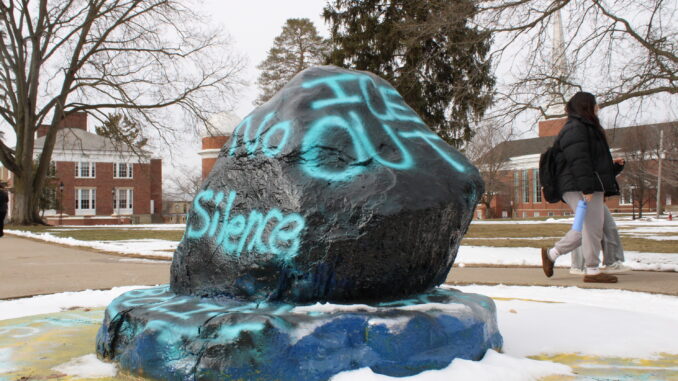
Alfahed said personal actions are also meaningful during this time, “whatever those actions may be, be it painting The Rock, be it keeping posts on social media” or “just being ready for the next elections.”
“It never stopped in Minnesota, nor did it ever start in Minnesota,” Alfahed said. “It’s been everywhere.”
Kyla Lawrence also contributed reporting to this story.
Fuck ICE.
Thank you to the Pleiad for covering this story. I’m honored to be able to speak for my home and all the other communities being impacted. Keep doing amazing work!