
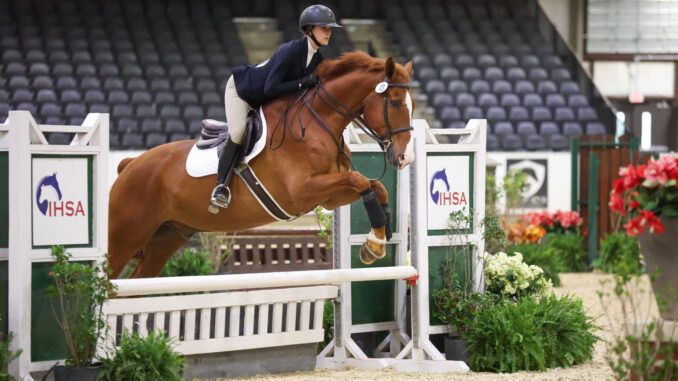
Athletes often pick colleges because of coaches, according to Carolyn Killewald, alumna ‘04 and equestrian center director of operations. That was the case for novice hunt seat rider and Willoughby, Ohio, first-year Anna Harvey, who said the deciding factor between “going to this school and going to another college” was former varsity hunt seat coach Chris Mitchell, who left the position in July.
Novice hunt seat rider and Scotch Plains, New Jersey, first-year Tiffany Yang said Mitchell left because “family comes first,” a departure open hunt seat rider and Hartland sophomore Anna Huard said was a “bummer” for the team, but there’s “no bad blood.”
With the search ongoing since July, the team has been practicing and competing without a head coach for the duration of the 2025-2026 academic year, Killewald said.
Despite this, the hunt seat team achieved two firsts this year: second place, or “reserves,” in their current region, and a Caccione Cup, an award won by hunt seat open rider and Algonquin, Illinois, senior Phoebe Martin that “goes to the rider in the whole region who has won the most points throughout the regular season,” Killewald said.
“I was really excited for them that they were able to do so well,” Killewald said. “Especially in light of not having a permanent coach the whole season.”
Riders Say Being Without a Coach is ‘Disappointing’; ‘Awful’
Yang said she discovered Albion through its equestrian program, adding that she “came ten hours away from home just to be a part of something that now has almost no meaning,” and being coachless feels “awful.”
Hunt seat limit rider and Whittenville, Washington, sophomore Rebecca Till was coached by Mitchell her first year but said adapting to this season without a coach has been “disappointing” and “upsetting.”
“I came here for the barn and for the coach; that was the number one selling thing for the school,” Till said. “And now, that’s kind of been stripped away.”
To support the team in this absence, Killewald said she’s “brought in a couple of different instructors” to “help teach lessons throughout the week.” This way, riders are “still getting instruction,” just not from “somebody who’s here full time,” Killewald added.
Till said having a full-time coach meant there “was a lot more structure last year,” so riders “were able to have consistent lessons.”
During Mitchell’s tenure at Albion, Huard said she had lessons “four to five days a week.” Huard said she presently has one lesson a week and one 30-minute solo ride. She added that she likes to ask other athletes to imagine their practices being scheduled like the hunt seat team’s this year:
“You have 35 to 45 minutes to the court by yourself once a week, and then you have another day that you have an hour with the team,” Huard said. “Now go win an MIAA. That’s impossible. It’s a really hard ask.”
Harvey also said these scheduling changes have impacted her ability to have lessons and that the two visiting instructors are only available three days a week. Last semester, she rode on two of those days, but her class schedule changed her availability this semester.
“I ride on Mondays and Fridays, which means that I actually, this semester, don’t get lessons,” Harvey said. “I just go in and ride.”
‘Our Team’s Really Come Together for This’
Limit hunt seat rider and St. Clair Shores senior Isabelle Adkins said, “ironically” during her first year, her class “came in without a coach,” adding, “We’re leaving without a coach again, which is kind of funny.”
Four years ago, Adkins said the seniors were a “big source of communication” to help first-years understand the program, but she’s since transitioned from first-year to senior.
“Now I’m the source of communication for the freshmen who have no clue what they’re doing, and it’s a very full circle moment,” Adkins said. “Our team’s really come together for this.”
Till said she wanted to “emphasize” that although the team doesn’t have a coach, the riders “will do anything for the team.”
“We have helped each other. And we coach each other,” Till said. “We give pointers, and we really have been supporting each other. So our team itself, we’re really strong.”
Next Steps; Staying ‘Resilient’
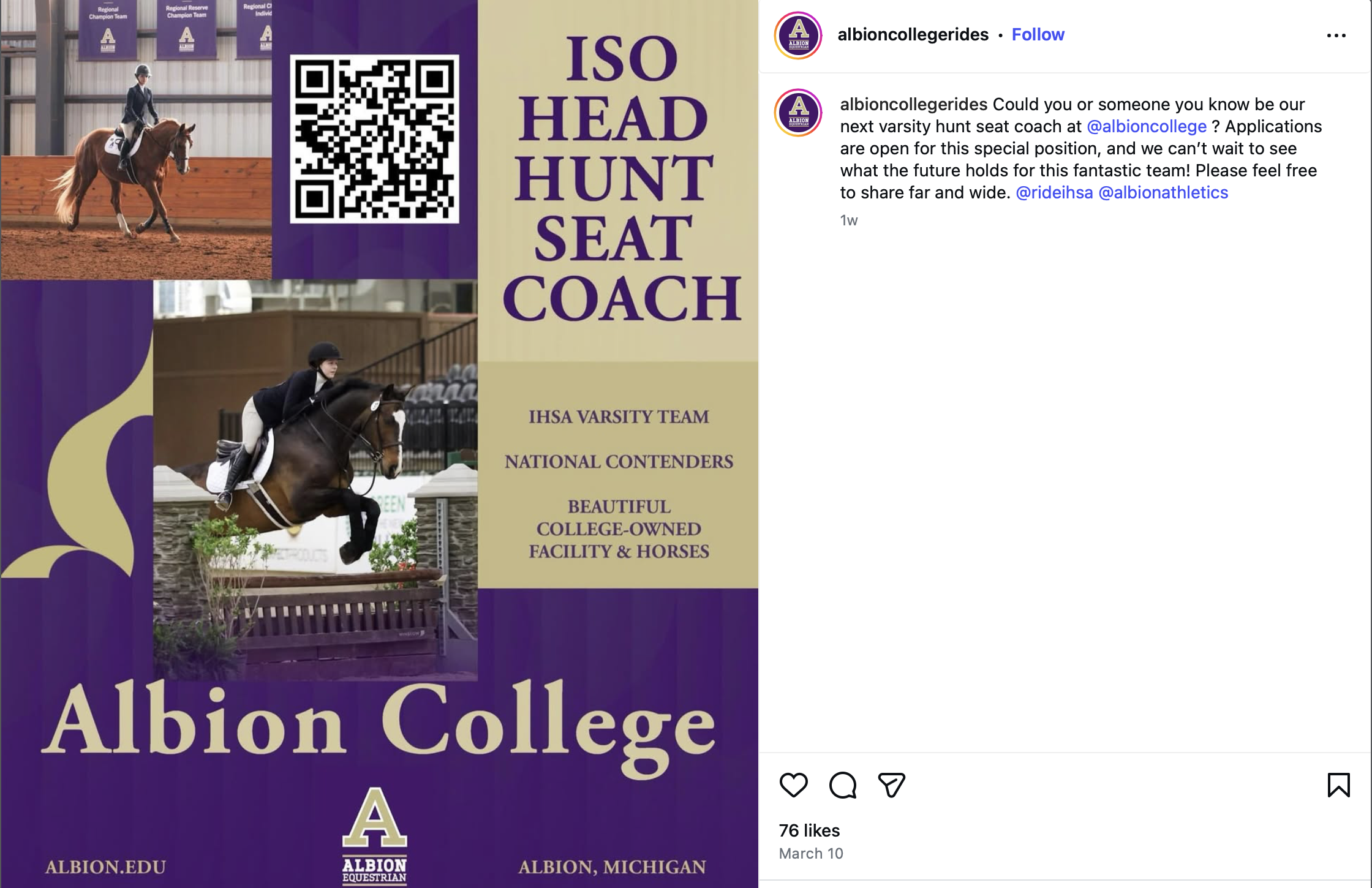
Director of Athletics Jennifer Rushton said the hunt seat head coach position is “open,” adding that the department is looking for a “leader” to “help our student athletes grow personally.”
Killewald said that while Mitchell was coaching, he “really brought the team up to a certain level,” adding that she doesn’t “want to go down from there.” To ensure the team keeps that momentum, Killewald said she is “very picky about who we bring in as the coach.”
“I don’t want to just hire any Joe Schmo off the street and say, ‘Oh, there you go. I filled the position,’” Killewald said. “I want to make sure it’s somebody that’s really qualified and that is gonna take the team and get them out there and keep them successful.”
According to Harvey, she is “appreciative that the athletics department is taking their time” and “trying to hire somebody with care in mind” rather than “hiring the first person that comes up.”
“I would rather have a good quality coach than just whoever,” Harvey said. “But at the same time, it’s like, we’re just here. I hope they have somebody by next year.”
The team usually earns third in their region, according to Till, but she said that this year they “got second, and that’s without a coach.” She added that the team has been “super resilient.”
“We’ve really stuck together and made it work, and we want to keep making it work,” Till said.
Killewald said she’s “super excited” for the three riders who “qualified to go on to zones,” which are on Saturday, adding if they finish “top two in their classes at zones,” they’ll advance to nationals from May 1 to 3.
Killian Altayeb also contributed reporting to this story.
Leave a Reply