
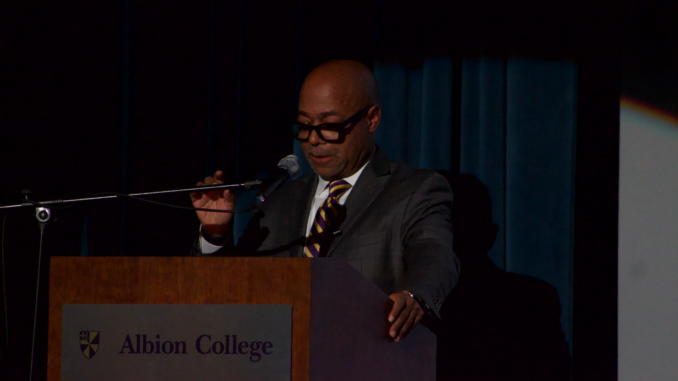
Teachers have often been pushed to the margins of history despite their influence on the younger generation, something that Derrick Alridge, professor of education and the convocation’s keynote speaker, sought to change.
Alridge presented his keynote address, “Teaching the Dream,” at the annual Reverend Dr. Martin Luther King Jr. (MLK) Convocation and Community Celebration on Monday, where he highlighted the work of Southern Black teachers in the Civil Rights Movement.
To find a speaker for the convocation, Executive Director of the James L. Curtis Institute for Social Change Ari McCaskill said in an interview before the event that he met Alridge at a conference in Atlanta, where they bonded over being in the same fraternity, Omega Psi Phi. After attending a panel where Alridge spoke about his work, McCaskill reached out to Alridge, who agreed to speak at the convocation.
McCaskill said the convocation is an “important” community event because it reminds both students and community members that education is a “privilege” and “true liberation.”
“Memorializing MLK as an integral component of acknowledging that democracy does well, even at times of challenge and strife,” McCaskill said. “Challenging systems towards social equity, towards universal justice, towards universal peace, benefits the greater good.”
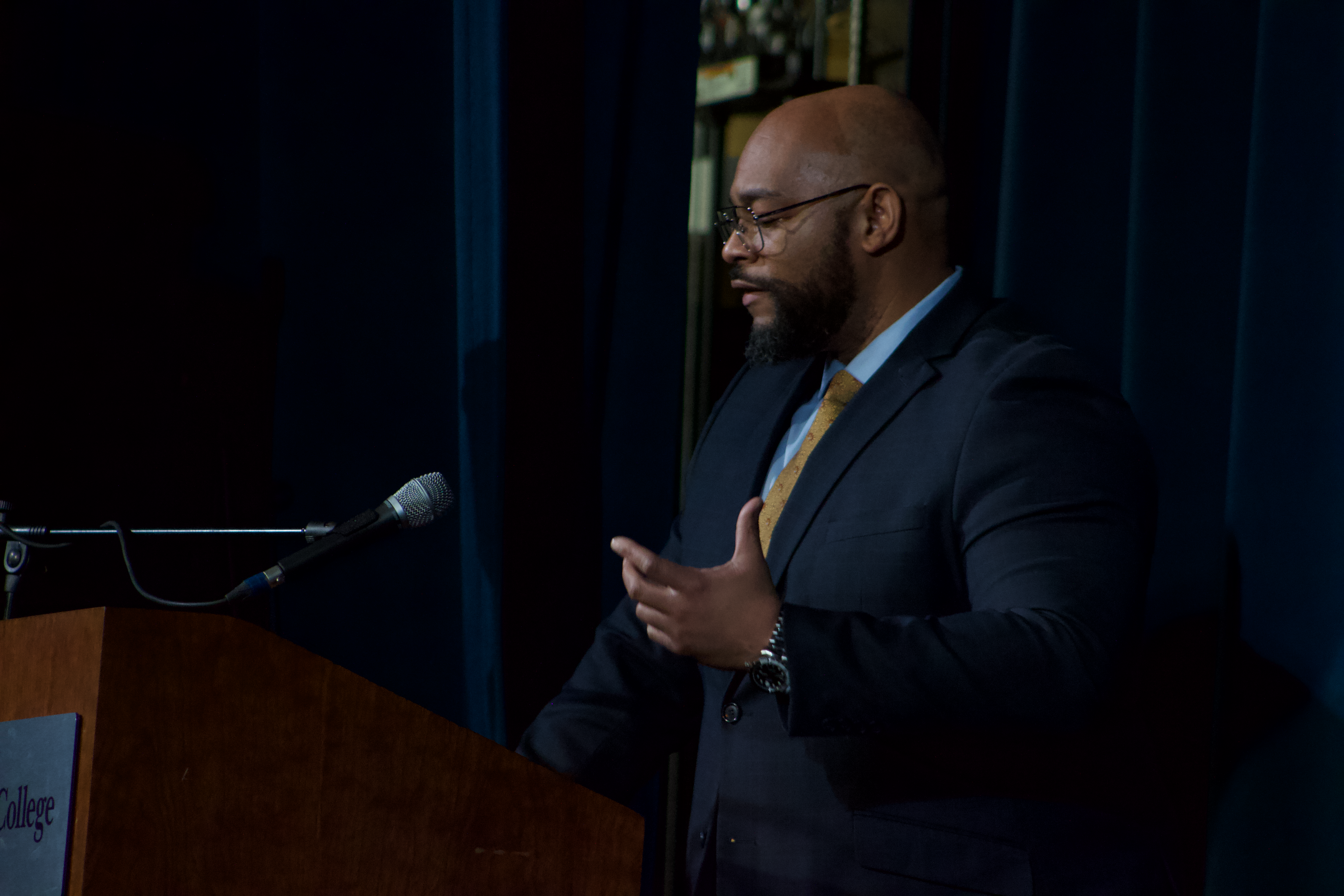
Executive Director of the Gerald R. Ford Institute for Leadership in Public Policy and Service Eddie Visco said in an interview before the event that he plays a “small” role in organizing the convocation, and celebrating King’s legacy of promoting “equitable, diverse communities” is part of the “mantra” of what the Ford Institute is about.
“Not only are we looking into taking more of a historical aspect of civil rights and thinking about how teachers play their role in that, but also recognizing members of the community,” Visco said.
In the convocation’s introduction, Associate Director of the Office of Belonging Rivkah Gamble encouraged the audience to “recommit” to furthering the “values and beliefs” of King. Gamble also spoke about how Black teachers participated in the Great Migration to “instill the conditions of learning and discipline” for the children they cared about.
“In many communities, Black teachers were more than instructors,” Gamble said. “They were mentors and advocates. They introduced students to worlds outside their classrooms and states, and they were often the loudest voices insisting and encouraging our young people to succeed.”
During his keynote address, Alridge spoke about what he learned from talking to Southern Black teachers in his research project titled “Teachers of the Movement,” in which he and his students conducted over 500 interviews of Southern Black teachers.
According to Alridge, this project is one of the most “significant” archives of Black teachers’ experiences in the country.
“We sat in church fellowship halls, school libraries. We listened, and we learned. We recorded stories that had never been documented before,” Alridge said.
Based on the interviews, Alridge said his team created a new definition of the everyday activism that Southern Black teachers engaged their students in, calling it “pedagogical activism.”
“Teachers taught Black history when it was not in the curriculum,” Alridge said. “They cultivated dignity and respect and model democratic ideals, they challenged inequality through pedagogy and they prepared students to navigate and transform an unjust world.”
Alridge said the teachers he talked to gave him a new perspective on storytelling as a whole. He referred to them as “griots,” or storytellers, and approached interviews with a “flow of intuition,” allowing the interviewee to take control of the interview.
“I consider myself a custodian of their stories because they gave them to me out of trust, and I want as much as possible to present these stories to the public in a way that they would want me to present them,” Alridge said in an interview after the event.
The last thing Alridge said he learned was the importance of “communal bonds” and “establishing relationships.” He gave an anecdote about being nervous to interview a teacher, and the way he broke the ice was by asking about her home’s pink and green walls. Alridge came to find out that, like his wife, she was a member of Alpha Kappa Alpha, and her husband was also a member of Omega Psi Phi.
Alridge said King “expressed a deep admiration” for teachers in the civil rights movement and even considered becoming one himself. To Alridge, teachers are “architects of possibility” who “cultivate critical thinking” and “affirm” the humanity of the children they teach, which is how they “care” for King’s vision.
“May we continue to teach the dream,” Alridge said.
Leave a Reply