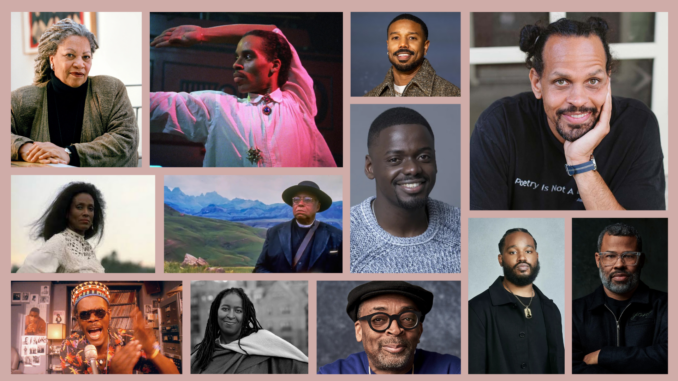
All throughout the year – not just during Black History Month – the Pleiad strives to uplift and shine a light on Black voices. When not highlighting Black student athletes’ experiences or Black student leaders, we are students who engage in multiple forms of media.
With multiple wins by Black artists at the 68th Grammys and performers at the 83rd Golden Globes, there’s plenty to celebrate this and every year.
Editor-in-Chief, Bonnie Lord
Over the winter break, I set a goal for myself: read more books written by Black women. I picked two I had been recommended before, the first of which was “Hood Feminism: Notes From the Women That a Movement Forgot” by Mikki Kendall.
Kendall pulls no punches writing about her experiences as a veteran, mother, author and not so simply, as a woman. For anyone looking to understand feminism and its inherent biases, consider this a riveting textbook.
The second book I read over the break was “Soil: The Story of a Black Mother’s Garden” by Camille T. Dungy. The book is part memoir, part poetry and part garden manual, complete with maps of Dungy’s flower garden inside the covers.
As for movies, “Sinners” (2025), directed by Ryan Coogler, was obviously incredible. After I watched it at the Bohm Theatre, the movie immediately ended up in my Letterboxd top four, and I called everyone I knew to tell them to watch it. “Nope” (2022), directed by Jordan Peele, was a similar story – I’ve rewatched it maybe three times in as many years – it always leaves me feeling utterly moved.
On the auditory front, and similarly garden-related, Ross Gay’s poem, “Catalog of Unabashed Gratitude,” is one of my favorite poems ever written. To hear him pronounce every phrase with joyful intention against Bon Iver’s haunting background music is genuinely enlightening – everyone should listen to this track.
Managing Editor, Jocelyn Kincaid-Beal
I couldn’t really find a way to be chill about this or narrow it down much, so I decided to organize my recommendations by media type and go from there.
For poetry, I recommend the collections “Citizen: An American Lyric” (2014) by Claudia Rankine and “Don’t Call Us Dead” (2017) by Danez Smith. I also recommend the poems “We Real Cool” (1963) by Gwendolyn Brooks and “Ghazal for Becoming Your Own Country” (2016) by Angel Nafis. Other fantastic Black poets include, but certainly are not limited to, Nathan McClain, Jamaal May, Patricia Smith, Nate Marshall and Jamila Woods.
For books, I recommend the novels “Passing” (1929) by Nella Larsen, “Kindred” (1979) by Octavia Butler and “The Trees” (2023) by Percival Everett, as well as the nonfiction “The Black Panther Party: A Graphic Novel History” (2021) by David F. Walker and Marcus Kwame Anderson. These are all books that I’ve read in Albion College classes, and I thank and commend the professors who assigned them for doing so. These books explore different parts of Black history, and they’re all engaging and enlightening reads.
In terms of movies, I’ve narrowed it down to “Tangerine” (2015), “Hidden Figures” (2016), “Get Out” (2017) and, of course, “Sinners” (2025). You also can’t go wrong with anything else directed by Jordan Peele or Ryan Coogler. Jordan Peele has his own production company called Monkeypaw Productions, which, according to its website, “champions highly specific perspectives and artistic collaborations with unique and traditionally underrepresented voices.” Anything produced by Monkeypaw automatically goes on my Letterboxd watchlist.
Assistant Managing Editor, Killian Altayeb
I’ve been extremely lucky to have occupied spaces with good media recommendations, so it’s challenging to narrow down my favorite media that centers Black voices.
“Paris Is Burning” (1990) is a documentary most people know and offers an incredible look into Black and Latinx queer ballroom culture in New York City. What stands out to me most is how the film centers on chosen family and survival in the face of horrific racism, poverty and homophobia. It shows that Black history is not only about suffering but also creativity, performance and the act of defining yourself on your terms. Furthermore, engaging in media that honors those who have passed is essential to me.
I’m also a gigantic fan of “Cry, the Beloved Country” (1995). Through the story of a father searching for his son, the film shows how systemic racism fractures families and communities. What makes it so powerful is its emphasis on moral struggle and grief. Also, James Earl Jones is in it, so enough said.
Lastly, I would be disgracing my love of the Sundance Festival if I didn’t mention “Daughters of the Dust” (1991). The movie centers on 3 generations of Gullah Geechee women, and I love the story’s connection to land and water. I’m especially moved by the hand-dyed dresses within the film and the choice of Pamela Ferrell as the film’s hairstylist.
Features and Opinions Editor, Heidi Faramelli
While I’d love to list every piece of media uplifting Black voices that I’ve ever loved, brevity is the soul of journalism, so I’ll try and stick to a few.
I have yet to see the newer version of “The Color Purple” (2023), but I watched “The Color Purple” (1985) last year on a whim, having felt the urge to watch a musical and something directed by Steven Spielberg.
I quickly learned that I had no idea what I was getting into. The film is gut-wrenching; the kind of media you watch, and it just makes your stomach sink. Still, it was a story that absolutely needed to be told, and I’m very glad I watched it.
I watched “Get Out” (2017) in my screenwriting class last semester, and I was on the edge of my seat the entire time. It’s absolutely horrifying. I would rather not give away too much because of the twists and turns it contains, so I simply urge you to watch it and see how incredible it is for yourself!
The last live-action film recommendation I have is “Django Unchained” (2012). Jamie Foxx’s acting is truly unmatched in this film, and the story is action-packed through and through.
I’ve always loved “The Princess and the Frog” (2009); its gorgeous depiction of New Orleans has made me want to travel there since I was a kid. It’s so important to have diverse Disney princesses – all children should have role models to look up to who look like them, no exceptions.
I recently rewatched “Soul” (2020) with my fiancé and was reminded of how much I enjoyed it when it first came out. Although it’s technically a children’s film, its themes of morality, life’s purpose and what it means to feel fulfilled go much deeper than the average cartoon.
I wouldn’t be an English major without mentioning a couple books pertaining to Black History Month. Kristen Gentry – who I had the honor of introducing when she came to our reading series – wrote a short story collection titled “Mama Said: Stories” (2023). It takes place amid the end of the crack epidemic and the rise of the opioid crisis, and it’s one of the best collections I’ve ever read.
Lastly, I’d be remiss not to mention the incredible “Let Us Descend” (2023) by Jesmyn Ward. I read this in Jess Roberts’ class, and the novel honestly changed my life and the way I understand history. It’s both harrowing and hopeful, but those adjectives don’t do it nearly enough justice – it’s something I think everyone needs to read at least once.
Part-Time Multimedia Journalist, Sophia Valchine
My favorite media that relates to Black History Month is any and every book by Toni Morrison. Morrison has won awards ranging from the Presidential Medal of Freedom to a Pulitzer Prize for her novel “Beloved” (1987), which is my favorite book of all time. She was also the first Black woman to be awarded a Nobel Prize for her novels that delve into the worlds of Black communities and how race interacts with gender, social standing and more.
I first read “Beloved” in an English class, and I instantly fell in love. Morrison’s prose reads like poetry, especially in her novel “Jazz” (1992), where the flow of the writing almost imitates the rhythm of jazz. Her novels explore issues that I am wholly unfamiliar with, and she gives people like me a chance to see into a world that exists alongside the one I am familiar with in a way I haven’t before.
Her characters feel like real people; I think about the characters in “Beloved” at least once a week, and the thought is usually “these people changed my life forever.” Since reading “Beloved,” I have been on a mission to read every novel Morrison has written, and I am getting very close to my goal. I would recommend that everyone read at least one Morrison novel in their lifetime; she has important stories to tell.
Part-Time Multimedia Journalist, Kai Taylor
Being a major cinephile, it’s hard not to write a full-on essay about this topic, so I’ll just list my top three. The first one I’d like to shout out is “Sinners” (2025), which is terrific. Ryan Coogler, who directed and wrote the film, blends horror with racism, music and some really cool action scenes.
In the film, two brothers open up a juke joint – and then have to fight for their lives against the undead. If that doesn’t sell you, I don’t know what will. It’s really awesome to see an original movie that did so well commercially and was a directing masterpiece coming out of Hollywood. “Sinners” also just set the record for most Oscar nominations in history, in case you have any doubts about its excellence.
“Get Out” (2017) follows the horror genre, with Jordan Peele making his directorial debut in this dark comedy-turned-thriller. The racial undertones of this paranoia-induced horror, combined with Peele’s signature comedic style, bring together a super unique experience that you just have to watch to understand. Daniel Kaluuya is lights-out good in this movie, with one of the most underrated performances of the decade. Even if you’re not a horror fan, “Get Out” and “Sinners” are amazing watches.
However, my personal favorite has to be “Do the Right Thing” (1989). Spike Lee, a director who needs no introduction, hits on every cylinder in this movie, providing a three-act saga in Bed-Stuy, New York, about an argument in a pizza restaurant. Lee’s frustration with the division between races comes into play and is really as relevant now as it was in 1989. And, who could forget Radio Raheem’s speech on love vs. hate? It’s a message that we all need to hear in 2026. Just watch it. You will not regret it.
I think it’s important in every aspect to get a diverse portfolio of backgrounds; that way every movie, book, TV show, etc. isn’t from the exact same perspective. Personally, if I had the same meal every single day, I would yearn for something more eventually. It’s really cool to see the array of voices represented to weigh in on the world’s issues through different lenses.
One way or another, these films tackle the subject of race in America through the lens of an African American. They provide a way to see another side to the story and become more aware of the issues in our country through it. And, cinema is a great way to convey those messages and themes. Even through the shortest movies, we can gain a larger understanding of the world.
Volunteer Multimedia Journalist, Kristal Tiburcio
“Hidden Figures” (2016) was such an amazing and eye-opening film. The movie gave us iconic lines and amazing scenes that represent the frustration of what it’s like to live, work and try to thrive in spaces that are white-dominated. It centers around three Black women, which is rare to see. Even in cinema, the field is dominated by male-centered stories, and just this once we see these women shine with achievements they no doubt worked hard for.
There is a certain amount of avoidance that movies often take towards the anger that marginalized groups feel towards their experiences. The scene with Katherine finally bursting out in desperation from challenge after challenge felt so nice. Raw frustration is such a refreshing emotion to see from women who are so usually composed, because we are all human. It would be hard to assume that anyone can live with discrimination day after day without it affecting them.
This movie not only highlights three Black women who had a real impact on history, but it also made me realize just how many workers of color were likely forgotten as well. It’s common for the U.S. to hide and bury the facts they don’t think are flattering. I wouldn’t have found out about Dorothy Vaughan, Katherine Johnson or the role that Black women played in NASA without this movie; I highly recommend watching it.
Leave a Reply