
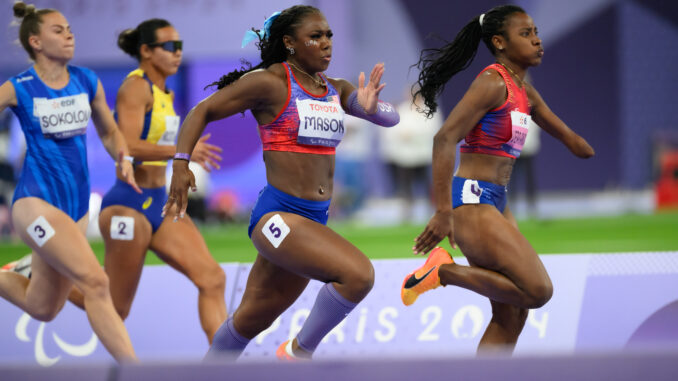
When my brother and I were kids, our babysitter was Brittni Mason, five-time Paralympic medalist and T47 100-meter dash world-record holder. Between college classes, track practice and Paralympic training, she would pick us up from school and spend time with us until our parents got home from work.
When the Tokyo Paralympic Games began in 2020, I was so excited to see Mason compete that I told all my friends at school to watch her races. While some of them were just as enthusiastic as I was, most had the same question:
“What are the Paralympics?”
There are a few reasons why my friends didn’t know these events existed. From a lack of media coverage to the misconception that Paralympians are not elite athletes, the Paralympics are often forgotten about and overshadowed by the Olympics.
With the Milano Cortina 2026 Winter Olympics ending on Sunday and the Winter Paralympics scheduled to kick off on March 6, it’s important that we tune in to watch disabled athletes with the same enthusiasm and interest we had for the able-bodied athletes who competed earlier this month.
More Competitions, More Entertainment
If you loved watching the Olympics, don’t be sad they’re ending – the Paralympics are right around the corner.
There are two more weeks of athletic competition for you to enjoy and plenty more gold medals to be won – in fact, more medals are awarded in the Paralympics than in the Olympics because there are more athlete classifications and therefore more races and games.
This makes the events especially engaging because you can watch people with different disabilities competing in the same sport. You can learn, for example, how different skiers perform, depending on whether their disability affects their arms, legs or vision.
This difference in performances also means there are slight changes made to the sports to accommodate various disabilities. Not only are viewers learning the rules of the sport, they’re also learning the modifications that allow as many athletes as possible to compete.
One of my favorite winter sports with such modifications is Paralympic (Para) ice hockey, formerly known as sledge hockey.
Created for hockey players with lower-body impairments, the game requires players to sit in a metal sledge (or sled) with two blades underneath, which take the place of ice skates. Each player also has two double-sided sticks. One side has a spike that is driven into the ice and used to propel players forward, and the other side has a hockey blade that allows them to handle the puck.
The rules of Para ice hockey are almost identical to the rules of ice hockey, but there are some differences. For example, the use of spiked sticks requires rules that restrict the size of the spikes for player safety. There is also a unique penalty called “teeing,” which is when a player intentionally hits another player with the front of their sledge.
These changes make Para ice hockey entertaining to watch, and it’s quickly become one of the events I look forward to the most.
Incredible Athletes
The Games wouldn’t be as entertaining as they are without the people who participate in them. Each athlete has their own story of how they got to the top, and watching the Paralympics is one way to follow along with them on their journeys.
Some athletes are on the brink of making history in Milano and Cortina next month, which will make for an exciting watch.
Oksana Masters has the most medals of any American Winter Paralympian athlete, with 14 medals from the Winter Paralympics and 19 medals overall. She is a three-sport athlete, specializing in Para-rowing, Para Nordic skiing and Para-cycling.
Masters, who recently recovered from hand surgery, is set to compete in Milano and Cortina, which will be her eighth consecutive Paralympic Games.
Chinese wheelchair curler Wang Haitao is another athlete to look out for. Haitao has won gold medals in the last two back-to-back Paralympics and is looking to lead China’s wheelchair curling team to a third consecutive victory next month.
There are several others also aiming to make history during the Paralympics, so every event is expected to be highly competitive. If you love seeing athletes compete to be the best of the best, these upcoming Games are the ones to watch.
Learn Something New
Not only is it good to support Paralympic athletes, but you can also get a lot out of watching these events. Part of what makes them so important are the things they can teach you.
There are ten categories of disabilities recognized at the Paralympics, and athletes are grouped together within each category based on the severity of their disability. This classification system also depends on the sports themselves and how certain disabilities might affect an athlete’s performance in each one.
Watching the Paralympics could teach you about disabilities you didn’t know existed, as well as show you how they impact an athlete’s participation in sports. Some disabilities represented in the Paralympics are not visible, demonstrating that there is no one way to “look” disabled.
Ultimately, the Paralympics are an opportunity for the world’s best athletes to compete at the highest level possible despite their disabilities – but they are also a way for people to learn what it means to be disabled.
The Winter Olympics were a lot of fun to watch this year, but the fun’s not over yet. Although Mason doesn’t compete again until the Summer Paralympic Games in 2028, I intend to tune in to the Winter Paralympics next month to see more amazing athletes do their thing. I hope you will do the same.
Leave a Reply