
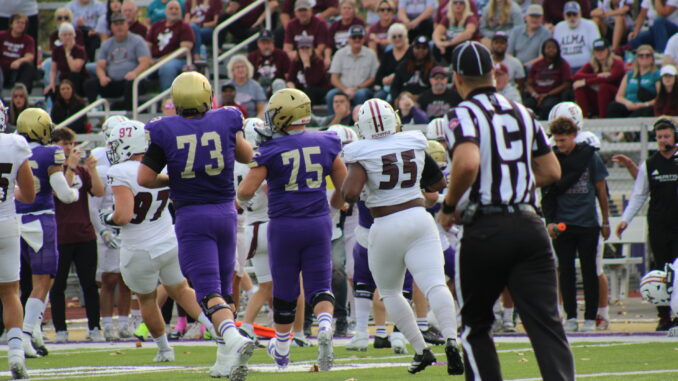
When attending a football game, volleyball match or anything in between, players and coaches are typically the most visible figures. However, each event relies on a broader network of staff and students whose work ensures sporting events run as smoothly as possible.
Each person and team within the athletic department has their own obligations – an ecosystem of tasks that keeps everything moving.
Funding, Prepping the Fields
For the athletic department to function, funding is necessary. Eric Scott, alumnus ‘01 and director of athletics philanthropy, handles major gifts from other alumni who he either calls or meets in person.
“If they have an affinity to support the department, we’re happy to facilitate that,” Scott said.
The work is not only financial stewardship, but also building relationships with alumni. Scott said connecting with former athletes and learning about the history of Albion athletics makes him “proud” to be an alumnus.
“That’s the best part, is hearing about all these names and these coaches that you know are on the wall, and you hear this thread of ‘they cared about me as an individual,’” Scott said.
Director of Grounds John Hibbs said he and his team tend to the grass baseball and softball fields, as well as the artificial turf fields for soccer, lacrosse and football. They fertilize and water grass, repainting lines as needed to ensure each field is game-ready.
Grounds’ main goal is to keep the campus and athletic department looking the best they can, Hibbs said, and he is on campus “before people usually get out of bed.” Hibbs added his favorite part of the job is seeing the “fruits of everything” that his staff has accomplished throughout the year.
“We work awfully hard; we take a lot of pride in what we do because we understand that a lot of what we do is the first thing people see when they come to campus,” Hibbs said.
Announcing, Calling
Coldwater senior Logan Farmer works as a caller – the person who tells the sports announcer what is going on as they follow along with the game. Farmer said he has called for soccer, volleyball, basketball and football.
“Sports don’t run without it,” Farmer said. “It’s very important for this to be getting done.”
The plays Farmer calls during games are recorded and sent to the National Collegiate Athletics Association (NCAA), he said, an organization that oversees the scores of each team and is responsible for giving out awards.
Rochester sophomore Matt Sypniewski said he has worked in several behind-the-scenes roles, including calling, announcing and keeping statistics and records. His favorite is announcing, he said, because he can “get the crowd going.”
“There’s something really unique to it, and you can put your own spin on it, especially adding a little bit of energy,” Sypniewski said.
Farmer said his position is one of the “best jobs on campus,” and being part of a team and interacting with people is something he enjoys.
“It’s a great culture to be around, and you get to meet a ton of new people,” Farmer said.
Sypniewski said it’s “easy” to work with other students behind the scenes, and things get done quicker and run smoother for the entire crowd because of their teamwork.
“It’s not only for people on campus, but other people who are coming here and playing against us,” Sypniewski said. “We’re putting our effort into it so it can be one of the better events around.”
Athletic Training, Communications
Andy Lawrence, associate athletic director and previous athletic trainer, is still involved in athletic training, which he said is “all-encompassing.”
“We’re the first line of defense in terms of an athlete’s injury,” Lawrence said.
When an athlete is injured, athletic trainers will figure out what is wrong and talk the athlete through the process, Lawrence said. They make sure to address both the physical and mental impacts of the injury, and Lawrence added the staff may work with the Cutler Center to communicate with professors when athletes might need to miss class for concussions or surgery.
“There’s a lot of moving parts to athletics,” Lawrence said. “Anytime you think you’ve thought of all the issues that could arise, something might come up.”
Assistant Athletic Director and Head Athletic Trainer Adrian Sanchez said Albion’s athletic program has its own doctor at Henry Ford Hospital who oversees each team.
“Working with us helps you have a more fluid and more hands-on approach to your medical care,” Sanchez said.
Beyond medical care, Lawrence’s responsibilities include fundraising, managing facilities and problem-solving issues such as faulty headsets or parking concerns.
“You name it, if there’s something in athletics, there’s probably some piece of me that has probably helped or solved some problem with it,” Lawrence said.
Assistant Athletic Director Steven Kline said his responsibilities include covering social media, games management, livestreaming games, statistical keeping and website updating, with which he collaborates with the Office of Marketing and Communications.
“It’s a lot of little pieces that you don’t necessarily see,” Kline said.
One thing Kline said he enjoys is watching student workers learn new skills as they settle into their roles in record keeping or website maintenance.
“It’s more to try to build relationships across campus and get some more student workers and provide more opportunities for students on campus,” Kline said. “Especially with the new experiential learning requirement.”
Sanchez added forming relationships with student athletes and seeing them grow from their first to their last year is his favorite part of his job. When working with a student athlete on rehabilitation, Sanchez said he checks in on them constantly to work towards healing.
“I think that we have such a unique role where we are with kids at a more personal level than a faculty member would be,” Sanchez said.
Having a job like Kline’s means that the unexpected is really expected, he said, and an important part of keeping everything in line is problem-solving on the spot in order to have a successful game or event.
“It’s a role where a lot of people might not know who you are or what you might exactly do, but your work is also very public facing,” Kline said.
Leave a Reply