
Content Warning: This article contains spoilers for Albion College’s production of “Our Town.”
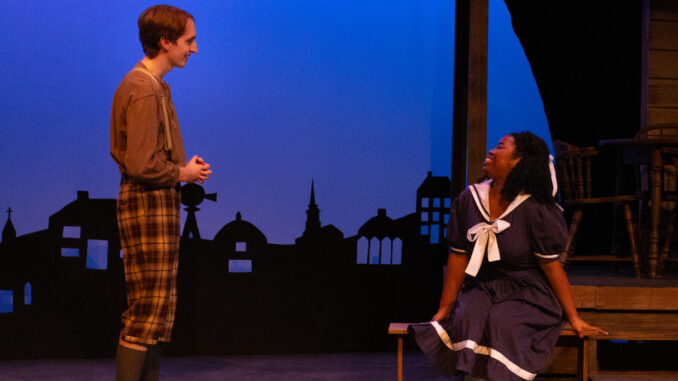
In my town – that is, Albion – there’s not always much to do, but the theater department’s plays are a good recurring option. In “Our Town,” their latest play, romance blooms, tragedy strikes and talented actors work with what they’ve got.
I wasn’t a big fan of the play itself, but I can still recognize that the actors did good work and the set was well-designed. That being said, I am left wishing the theatre department would consider their student audience more.
About ‘Our Town’
“Our Town”, a 1938 play written by Thornton Wilder, is set in a fictional small town in New Hampshire called Grover’s Corners. The play goes out of its way to explain this is a very ordinary town, with very ordinary citizens – nothing interesting happens there and most people never leave.
There are three acts: The first centers on a regular day in Grover’s Corners, the second is about the relationship and marriage between two characters and the third act, after intermission, revolves around a death. Wilder called the play “an attempt to find a value above all price for the smallest events of our daily life.”
In alignment with what Wilder said, my interpretation of the play was that it illustrates the importance of living in the moment and appreciating the little things in life. “Our Town” definitely gets its message across, but it’s not the most original message.
Zach Fischer, who directed Albion’s production of “Our Town,” called the play “a ghostly warning to slow down and be present” in the director’s notes of the program. Sure, you could call it that, but it didn’t resonate with me or strike me as unique from other narratives with similar morals.
I thought “Our Town” was fine. I know that’s not very descriptive, but that’s because I really can’t find much to say about it. I found the first two acts pretty boring; the third act was more interesting because ghosts were in it, which I enjoy, but it still wasn’t particularly moving.
Regardless, I’m glad others can appreciate it.
Appreciation for the Cast
Ortonville senior Seph Cartier, who played the role of “Stage Manager,” an omniscient narrator whose monologues begin and end the play, said the character was “unlike anything” she’d stepped into before, in that the Stage Manager speaks directly to the audience. I found the character to be familiar; I was reminded of the narrator in “Firebringer” and the stage manager in “The Play That Goes Wrong,” both plays put on by the theatre department in my time as a student.
I thought Cartier did well in the role, partially because I personally could never remember that many lines and the right times to say them. Cartier said “a lot of the work” she did to prepare for the role was “being more down to earth and more folksy.” Her desired tone definitely came across; I was convinced she was a long-time resident who could tell me anything I needed to know about Grover’s Corners.
Cartier appreciates the play and its legacy more than I do, which I think is admirable.
“This play has a lot to say obviously about life and about the connections that we make, both the ones we choose and the ones we don’t choose,” Cartier said. “I think it’s an important story to tell.”
The other main roles were Emily Webb, played by Dallas senior Alaecia Simmons, and George Gibbs, played by Coldwater sophomore Jeffrey Harvey, who get married in act two. Harvey and Simmons both convincingly played their characters at a few different ages and points in life.
Harvey said their favorite part of the play was getting to play a “clueless guy,” as opposed to the “evil” or “goofy” characters they’ve been in the past. Clueless is a good word for George Gibbs – he’s just sort of there.
Emily Webb is a more dynamic character, and, spoiler, she’s the one who dies. After her death, she attempts to relive a day of her life, and picks a childhood birthday – but she stops this, finding it too painful. It’s through Emily that the play explores its moral.
Simmons did a wonderful job of portraying Emily and all her emotions, from frustration, to joy, to anxiety, to grief. Simmons was brilliant in her roles in “Hedda Gabler” (1891) and “John Proctor is the Villain” (2022), and I’m happy she had a bigger role in this play.
Give the People (Me) What They Want (Newer Plays)
I think the theatre department could stand to consider their audience a little more when choosing plays. I don’t know how the department chooses which plays to put on, but I wish they would make more of an effort to put on plays that Albion students want to see.
For one thing, okay, sure, it’s a tradition to do a Shakespeare play every other year. Can we question that tradition, though? I’m an English major – I’ve taken classes on Shakespeare, and I know that his plays are an important part of the canon of English literature.
I also know that there have been thousands of plays written in the 400+ years since Shakespeare’s death. Do we really need to do a Shakespeare play every other year? There are only so many, and we’re doing the same ones over and over.
Next semester, Albion’s putting on “The Tempest” (1611) – which we last did in 2008, only 18 years ago. Mark Hoffland, a theatre professor and director who just retired in 2024, was here in 2008! It just feels too soon to be repeating it. I think it would be much more reasonable to do a Shakespeare play every four years – if we insist on keeping a pattern.
Speaking of repeats, and getting back on track, this is the fourth time “Our Town” has been performed by Albion College. Yes, it’s been over the course of 90 years, but I would much rather be watching plays never-before put on by Albion than watch ones that have supposed “historical value.”
My favorite shows that I’ve seen the theatre department do in my time here are “John Proctor is the Villain,” “2 AZ” (2015) and “Stop Kiss” (1999). I was also a fan of “The Aliens” (2010) and “In the Next Room” (2009).
Point being, please, stick to the more modern plays, Albion. I’m speaking as someone who’s been to almost every play since I got here; I should be a perfect example of your target audience. Leave the old plays for English and theatre classes, not for your performances.
And yes, I know there are other factors in choosing the plays that need to be considered other than audience opinion – I’m just sharing my perspective.
Closing the Curtain
For my closing monologue, I’d like to reiterate my support of the theatre department and all students involved in plays. I think your work is so cool; thank you for creating art and sharing it with the community.
Next semester, I will be seeing “Proof” (2000) directed by technical lecturer Stephanie Henderson, and yes, I will be watching “The Tempest” directed by Ian Geers, a colleague of Fischer’s. I wish the show wasn’t Shakespeare, but I don’t want to lose my viewing streak.
Although this is my final year at Albion, I’ll be happy to come back to see a play or two, as long as there’s something fun on the program.
Editor’s Note – 1:34 p.m. Monday, Nov. 24: The name of the director of “Tempest” was corrected.
I think this is a gross oversimplification of the theatre department. I can understand the message, however writing an entire piece on how the department is only producing antiquated productions (which you then go on to list several modern shows you’ve seen) only serves to alienate the small amount of the student body that attends performances or would consider attending. I think this take is reductive and more harmful than “good journalism”.
“I think the theatre department could stand to consider their audience a little more when choosing plays. I don’t know how the department chooses which plays to put on, but I wish they would make more of an effort to put on plays that Albion students want to see.”
“Point being, please, stick to the more modern plays, Albion. I’m speaking as someone who’s been to almost every play since I got here; I should be a perfect example of your target audience. Leave the old plays for English and theatre classes, not for your performances.”
Reading this review as an alum, I am struck by a fundamental misunderstanding in how an educational theatre program works. As an English major, you should know that even the old stuff still needs to be studied. For theatre students, especially actors, they need training in a multitude of techniques. They need experience acting in different kinds of plays. If an actor only performs in contemporary plays (like you have made quite clear you only want to see), then they will be woefully unprepared to enter a conservatory or the workforce. Actors need to perform Shakespeare and the old chestnuts because they will in their careers. Shakespeare is still performed everywhere (even a star-studded production of Twelfth Night this past year), why should Albion be any exception? Why should the Albion theatre department deprive its students of the opportunity to enhance their skills because the outside student body doesn’t find that experience worthwhile? The timing is such that most students can get the widest variety of experiences. I hope that the theatre doesn’t take this woefully uninformed review to heart. It’s a shame that “missing the point” is a common thread in many theatre reviews I’ve read.
Finally, if you want to see more contemporary theatre, there are plenty of colleges and professional theatres in the state of Michigan you can explore. Make sure you get your timing right, though, cause they all do “old plays” too.
I’m a little confused about this? Our Town is not supposed to be a play the general public will be able to laugh and have fun sitting through; it’s an illustration of life and what we don’t think about throughout it and if you can’t appreciate that then I have no idea why you opted to write a “review” on this piece. I come to see the plays at Albion because I know that they’ll put on something we can digest and think about, not some high-school comedy with no deeper meanings beyond the text. When I want to see a play like that, I will seek them out myself. Don’t attempt to be a theatre critic when the only theatre you enjoy are like the ones I just mentioned. Stick to writing about other things please, this is a very distasteful representation of the pleaid and can imagine pretty insulting to everyone involved with the production of the play.
First, I want to thank you for your review. I know these take a lot of time and energy, and I always think it’s nice that the Pleiad reviews our productions. Yes, Our Town can be boring, Wilder’s sentimentalism is definitely an acquired taste. It’s too bad you didn’t enjoy it, but we all have a right to our opinion. However, claiming that the message of Our Town isn’t original just demonstrates to me you didn’t do any research on this play. Our Town was written in 1938 and at the time was groundbreaking in its message, 4th-wall breaking style, and postmodernist design. The early 20th century language and pantomime style of acting was a challenge for our actors, and they worked incredibly hard to put on the performance you commended them for.
I don’t want to beat around the bush, I am absolutely furious to read that you didn’t do any research or critical thinking on how the theatre department chooses plays. You seem to have a fundamental misunderstanding of what our department is. The main function of these productions is to be an experiential learning opportunity for our student actors, designers, and technicians. To provide a well-rounded education and prep students for the professional world, Albion puts on a variety of period and modern plays. In the future, I suggest you consider the work that students put into their performances, rather than selfishly demanding that we “leave the old plays for English and theatre classes, not for your performances”. Every student involved in this production receives academic credit for their work. These ARE our classes. Your review might be acceptable for a professional theatre whose success is driven by ticket sales, but treating an educational department this way is incredibly reductionist and insulting.
If you are searching for more to add to a review, perhaps consider describing what you liked or disliked about an actor’s performance, the scenic design, the lighting, the sound, or the costumes. Consider your audience and leave play choice or writing criticism out of it, criticism of these topics is of no value to Albion students. When your hot take is “you shouldn’t have done this play in the first place”, you aren’t accurately assessing your subject. Thank you.
This is just bad.